
Cantor Prosthetic Soft Contact Lenses restore the natural appearance of the eye from disfigurements caused by ocular injuries, corneal scars, congenital coloboma, aniridia and traumatic iridoplegia. Cantor Prosthetic lenses can aid myopia, hyperopia and astigmatism, and they meet all prosthetic and cosmetic requirements.
Cantor Prosthetic lenses can be made in a variety of combinations: with a clear or black backing, an open or closed pupil, and in a wide range of base curves, lens diameters, iris diameters and pupil diameters and over. These are lathe-cut highly reproducible printed soft prosthetic lenses, with multiple ordering options, to help patients with many different eye conditions.
PARAMETERS: All measurements are in millimeters (mm) unless otherwise stated. Lens color is chosen from the Cantor Prosthetic Colour Guide, contact us to order your free sample.
- Base Curve: 8.00 to 9.40 (0.10 steps)
- Diameter: 13.00 to 15.00 (0.50 steps)
- Power: -/+ 30.00D (0.25D steps) – higher powers may be available
- Cyl: -6.00 DC to -0.75 DC (0.25 DC steps)
- Axis: 1° to 180°
- Iris Diameter: 11.50, 12.00, 12.50, 13.00
- Open Pupil Diameter: 2.50, 3.50, 4.50
- Closed Pupil Diameter: 2.50, 3.00, 3.50, 4.00, 4.50, 5.00, 5.50, 6.00, 6.50
- Occlusive Pupil Diameter: 3.50, 4.00, 4.50, 5.00, 5.50, 6.00, 6.50, 7.00, 7.50, 8.00, 8.50, 9.00, 10.00, 11.00, 12.00
- CC – Clear backing, Closed pupil – any combination is available
- BO – Black backing, Open pupil – any combination is available
- Available in Open or Closed Pupil
- Available in Clear backing or black backing (clear backing allows natural iris color through)
- Near-photographic in quality and vivid iris detail
- Patented chemistry creates a glossy, smooth front surface
- Consistent reproducibility
- Cantor Prosthetic lenses may include power and toric, and may be occluded upon request.
- Pinhole sizes are available, please get in touch for more information.
DESIGN: Cantor Prosthetic, Cantor Prosthetic Toric, Cantor Prosthetic Pinhole, Cantor Prosthetic Toric Pinhole, Cantor Occlusive, Cantor Prosthetic Donut, and Cantor Prosthetic Toric Donut.
MODALITY: 12 months maximum. Replacement frequency is at the discretion of the Eye Care Professional.
PATIENT EYE COLOR chosen from our free COLOUR GUIDES
A fitting set is not available for the Cantor Prosthetic lenses. However, we can provide a Cantor Prosthetic Colour Guide, which was designed to replace the fitting set.
Colour Guides are the eye color swatches used by eye care professionals to determine the most accurate color match. Colour Guides represent the array of colors that may be produced to match the patient’s natural eye color. Each color in the guide is numbered for ease of reference.
Since colors displayed on different computer monitors may not fully represent actual colors due to technological limitations, Medcorp provides physical and free Colour Guides which are swatches of the eye colors available in the Cantor Prosthetic and Nissel Custom lens lines.

Utilizing these Colour Guides enable Eye Care Professionals to determine the optimal color match to the patient’s unaffected eye. Providing Medcorp with photos of eye color selections is extremely helpful in deciphering the color match.
Medcorp will send two guides, one for the Cantor Prosthetic lenses (Blue Guide) and one for the Nissel Custom lenses (Green Guide) upon request. Keep these Color Guides in their original boxes to prevent fading of the color swatches.
FITTING GUIDE for Cantor Prosthetic Lenses
Fitting Procedure for Eye Care Professionals:
• Full refraction and eye examination.
• Keratometry.
• Select diameter minimum 2.00-3.00mm larger than HVID. A larger diameter may be more beneficial depending on purpose.
• Select base curve based on K readings. The following offers a starting point. For larger diameters, and further information, please contact us to assist with calculations.
| Lens Diameter (mm) | Steep K’s < 7.70 mm | Average K’s 7.80 mm – 8.35 mm | Flat K’s > 8.35 mm |
| Order base curve flatter than flattest K by (mm): |
| 13.00 & 13.50 | 0.70 | 0.30 | 0.20 |
| 14.00 & 14.50 | 1.10 | 0.70 | 0.60 |
| 15.00 | 1.50 | 1.10 | 1.00 |
• Order power calculated from spectacle Rx and adjusted for BVD. Please contact us if help is needed with conversions, toric prescriptions, or parameters outside of the above range.
• If the eye requiring the lens cannot be measured, then the other eye can be used as a guide.
• Order a fitting lens.
CARE: To avoid damage, extreme care must be taken when handling these lenses. The lenses must not be rubbed aggressively, rolled, folded or turned inside out. Hydrogen peroxide and barrel cases must not be used. Please contact us for information on caring for tinted lenses.
MODALITY: Cantor Prosthetic lenses are designed to last up to 12 months, the lens may need to be replaced more frequently, depending on the wear and care, and will be determined by the eye care professional. Contact us for further information or to request a free Colour Guide.
FITTING LENSES: Up to 2 clear fitting lenses will be supplied at no charge. It is important that a fitting lens is used, as there is no exchange or credit facility with this lens type.
LENS FIT: Insert lens and allow the lens to settle for 30 minutes.
| CHARACTERISTIC | GOOD FIT | STEEP FIT | FLAT FIT |
| Comfort | Good | Good initially | Poor |
| Centration | Good | Often good | Often poor |
| Coverage | Full limbal coverage in all directions of gaze | Often good | Poor |
| Edge | Good | May cause conjunctival indentation/blanching | Edge stand-off/fluting |
| Movement with blink | Good | Inadequate- None | Excessive |
| Push up test | Easily moved/recentres | Difficult to displace/slow recentration | Easily moved/poor recentration |
• If the base curve or diameter needs to be adjusted, then we would suggest ordering another fitting lens with the adjusted parameters.
Once happy with the fit, proceed with the following:
Carry out an over-refraction.
• Measure the pupil diameter in average illumination – if the eye is too damaged then use the other eye.
• Measure the Iris diameter – if the eye is too damaged then use the other eye.
• Choose the lens color required from the Cantor Prosthetic Colour Guide. This should be assessed in good, preferably natural lighting.
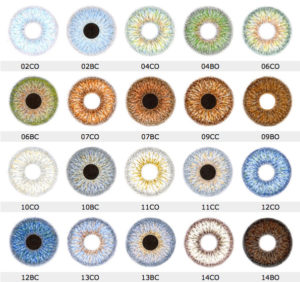
• Order the final lens stating base curve, diameter, Rx, pupil diameter, iris diameter, color code, as well as the backing and pupil type required as per the following codes:
BC – Black backing and Closed (Black) pupil
BO – Black backing and Open (Clear) pupil
CC – Clear backing and Closed (Black) pupil
CO – Clear backing and Open (Clear) pupil
Black backing will offer total occlusion over the iris, clear backing will allow the natural iris to show through. A lens with black backing and a closed pupil will offer total occlusion. Please note:
• If a Cantor Occlusive is required, only the diameter of the area of occlusion will be required.
• If a Cantor Pinhole Pupil is required, the clear pupil diameter will be required.
HOW TO ORDER Cantor Prosthetic lenses from Medcorp
Provide Medcorp with the following information via email:
MEASUREMENTS / PARAMETERS OF YOUR PATIENT’S EYE
- Base Curve
- Lens Diameter
- Iris Diameter
- Pupil Diameter
- Rx if necessary
OR
- K-Readings
- Topography
PHOTOS OF YOUR PATIENT’S EYE
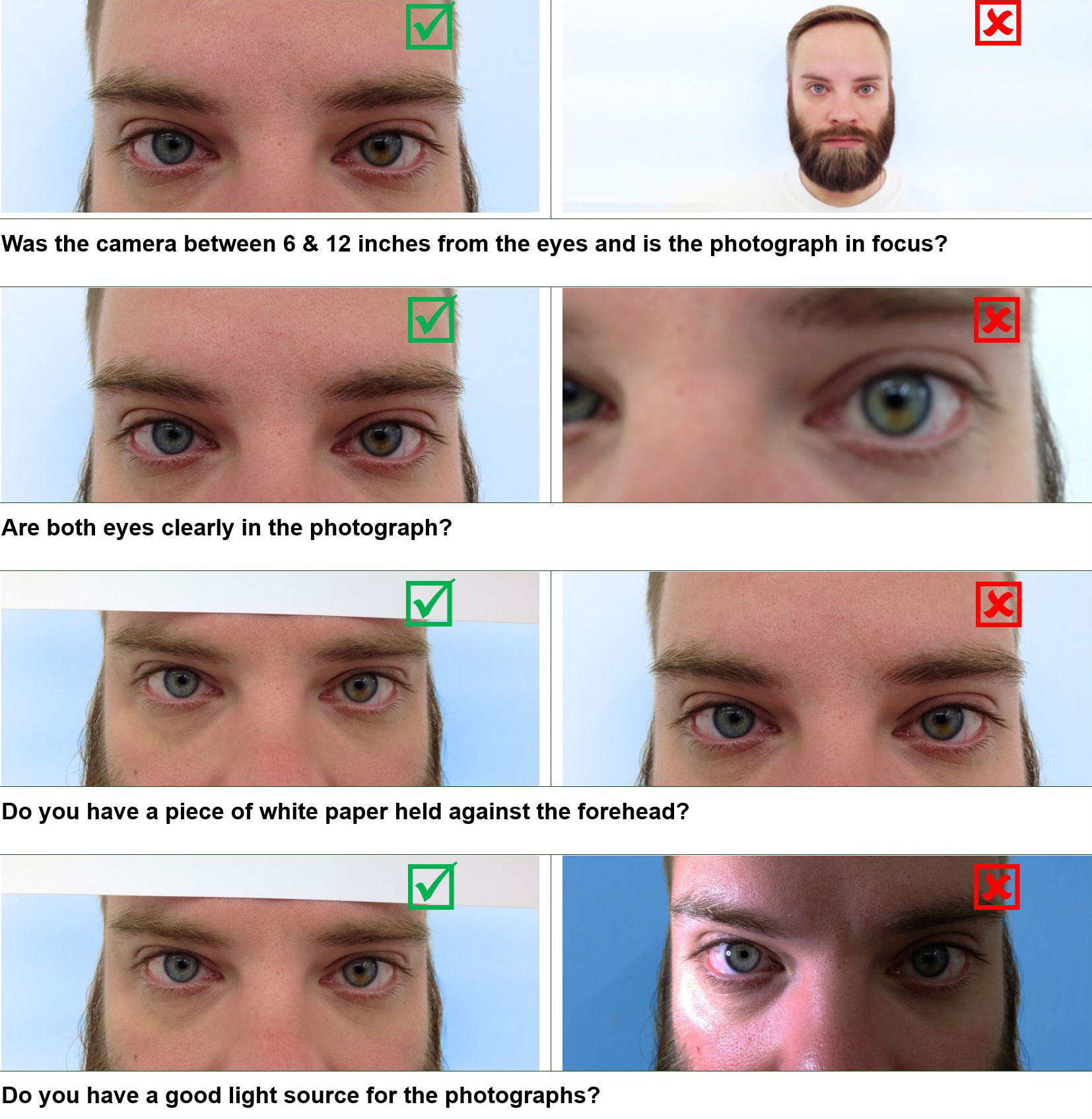
Photos, taken in natural light, 6-12 inches from the eye, NOT zoomed in, with a camera are helpful. We need clean, clear images that are sharp and focused. No Slit lamp photos, please. Take a look at this PHOTO CHECKLIST for your visual guidance, and refer to our Photo/Image Guide FAQs list below it.
Photo/Image Guide FAQs
Our lenses will only be as accurate as the images we receive!
WHAT DOES MEDCORP REQUIRE? Obviously, we can’t match a lens without a photographic image. However, the quality of the image will determine the overall quality of our finished lens.
I HAVE A SAMPLE – LENS CAN I USE THAT? If your patient has had a lens previously, we can use that to help making a new lens. The lens would need to be sent to our offices along with your order.
HOW FAR AWAY SHOULD THE PHOTOGRAPH BE TAKEN? Ideally the image should be taken between 6 & 12 inches away. A close image is not always best, please make sure the image is in focus.
DO YOU REQUIRE BOTH EYES IN THE PHOTOGRAPH? Yes. we will require both eyes so that a good match can be made, taking both eyes into consideration.
WHY DO YOU NEED A PIECE OF WHITE PAPER HELD AGAINST THE FOREHEAD? Our artists will require a base point to start from, using a piece of white paper will enable them to adjust the image to get a better colour match.
WHAT KIND OF LIGHTING DO YOU NEED THE PICTURE TO BE TAKEN IN? The picture is best taken with as much natural light as possible making sure not to have the light source behind the subject.
WHAT DO YOU DO IF THE COLOR OF THE LENS YOU RECEIVED IS WRONG? Although we make every effort to make sure the lens is correct first time, there are factors which may make the lens look different from the good eye. By sending us a new photograph with the lens on eye and the good eye in the same image, we can make any adjustments to correct the color.
We prefer that images be sent with an email in Jpeg (JPG) format rather than printed and sent by post. Images that cannot be used to reproduce a lens will be returned for improvement.
Exchange/Return Policy for Cantor Prosthetic lenses
Exchanges are for Fit and Color only. This can be done up to 60 days after receiving the prosthetic lens.
Please, visit our FAQs section for more information.